

We're always reading about the latest security exploit or distributed denial of service (DDoS) attack. When we do it tends to feel like something that happens to other people or businesses, and is generally a nuisance when it comes to our own lives. But could we be part of the problem?
There are a couple things you can do to determine if your devices are being used by nefarious actors to attack and compromise networks and services on the Internet. The first is to see if your network is exposing any openings that can be exploited.
The Shodan search engine is a great tool for determining if your network is exposing any open ports. Ports are like doors that allow outsiders to connect to devices within your network. There are 65,535 possible ports, some of which are standard ports used by common services. For example, web servers use ports 80 and 443 for insecure and encrypted communication respectively. Open up those ports and point them to a device on your network, and you're now hosting a public website.
This is where Shodan comes in. It allows you to search for your network IP to see what's open. You need to sign up to use the filters (it's free), but it's a one-step process if you simply sign in using a Google account. Then in the search bar you can search your IP address like this:
ip:73.198.169.112If you have exposed ports you'll see information about which ports and protocols are available. You can even search a subnet, representing a range of IP addresses, like this:
ip:73.198.169.0/24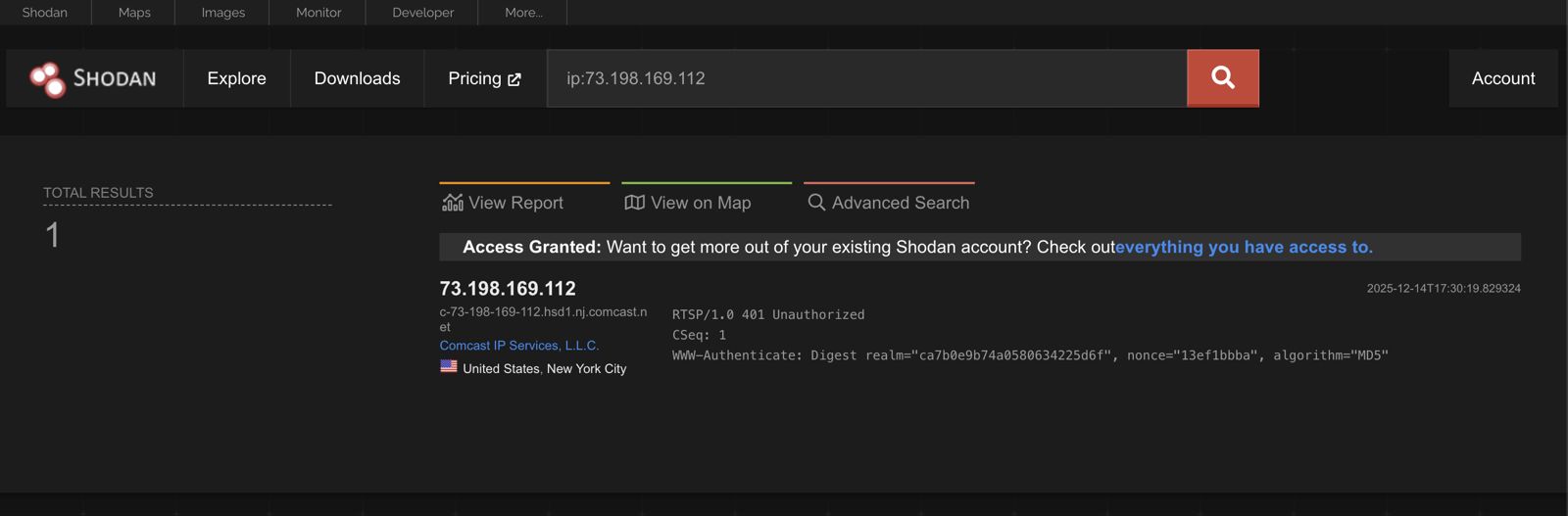 This IP address has an RTSP service port open to the world.
Suffice it to say that most people shouldn't have any results available. If you do, make sure the open port is supposed to be open. For example, if you're hosting a Minecraft server or website.
Another great, free, and simple tool is the GreyNoise IP Check. Visit the website and it will scan its massive botnet database to see if your IP address has ever been used in a distributed attack.
If your computer has been hacked and is under the control of someone on the Internet, they may use it (and your Internet connection) to participate in a distributed denial of service (DDoS) attack. That's when a large number of computers on the Internet make requests for a website at once, overwhelming the server and effectively taking it offline. These attacks are used for various reasons, like ransom demands.
GreyNoise watches the Internet's background radiation—the constant storm of scanners, bots, and probes hitting every IP address on Earth. They've cataloged billions of these interactions to answer one critical question: is this IP a real threat or just internet noise? Security teams trust their data to cut through the chaos and focus on what actually matters.
There's usually more to the story so if you have questions or comments about this post let us know!
Do you need a new software development partner for an upcoming project? We would love to work with you! From websites and mobile apps to cloud services and custom software, we can help!